
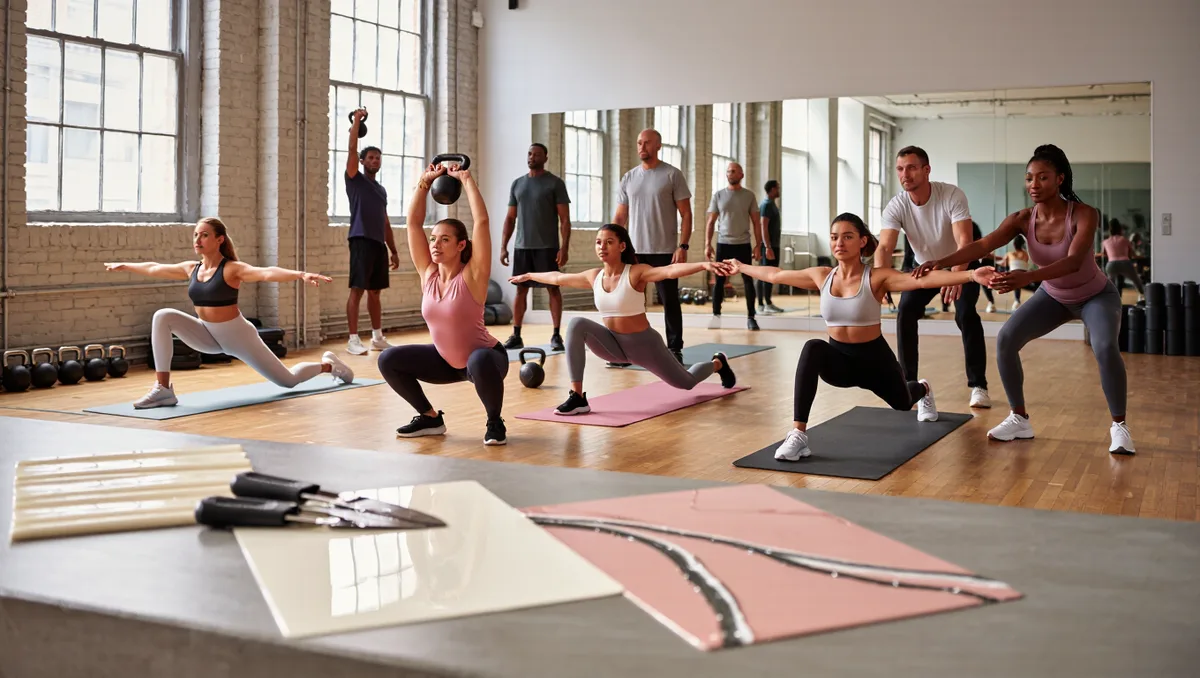
The best fitness class is not the hardest one or the trendiest one. It is the one you will actually keep attending — and Merriam-Webster defines "best" as "most productive of good," while the Free Dictionary renders it as "most satisfactory, suitable, or useful." Either way, it is a quietly useful way to think about exercise. Suitability, not superiority, is the whole game, at least in our view.
That matters because, in our experience, the class you dread is the class you skip. Search for fitness classes near you and options tend to appear quickly: bootcamps, spin studios, yoga rooms, boxing gyms, Pilates machines. The question worth asking first is not which one burns the most, but which one fits how you like to spend an hour. For related coverage, see Fitness Trackers and Step Accuracy: What Validation Studies Actually Measured.
Below, five temperaments matched to five class styles — plus a note on what no class, however well matched, can do on its own.
Do you thrive on energy and competition?
If a room full of people pushing hard makes you push harder, high-intensity formats may be your natural habitat. Bootcamps, HIIT classes, and competitive spin sessions run on group energy: loud music, a coach calling out intervals, and, in some studios, a visible scoreboard or leaderboard. The structure is simple — short bursts of effort, then recovery, repeated.
If you like this style, we would offer one caution: the honest answer about what intensity buys you is often more modest than the marketing suggests. In our view, the real advantage of a competitive class may be simpler — it makes an hour fly by, and showing up consistently is the outcome everything else depends on. That is an opinion about adherence, not a research finding, but it is the one we would stand behind.
Do you need calm, or does your mind race?
Some people leave a spin class wired. If that is you, a slower format will likely serve you better than a harder one. Meditative flow classes — slow yoga, breath-led movement, restorative sessions — trade intensity for pacing. The room is quieter. The instructions are fewer. Progress is measured in how you feel an hour later, not in calories displayed on a screen.
This is also where the wellness side of fitness lives. Movement that feels calming is a legitimate goal in its own right, and pairing a gentler class with other stress-focused habits is a reasonable approach, whatever those habits are. A gentle class costs less, asks less, and is, we would argue, far easier to attend twice a week for a year.
Do you like structure, numbers, and a plan?
Temperaments that love a spreadsheet tend to love strength-focused classes. Small-group strength sessions, barbell clubs, and reformer Pilates all share a trait: measurable progression. You add weight, you count reps, you notice the difference in a month. There is little improvisation and a lot of form coaching.
Two cautions from us, offered as practical advice rather than research summary. First, more volume is not automatically better in our view — more is not the same as better, and it is worth asking whether your plan is sustainable before adding to it. Second, planned recovery is part of the plan; we would not treat every scheduled class as mandatory. A numbers person who ignores recovery is, in our experience, a numbers person who stalls.
Do you bore easily and need variety?
If routine is the enemy, consider formats built on novelty: dance cardio, boxing conditioning, mixed-modality circuits. Each class changes. The music changes, the combinations change, the stations change. The tradeoff is real, in our view — variety-first classes tend to build skills more slowly than a structured strength program — but for a temperament that quits out of boredom, the tradeoff may be worth making.
A practical note: variety seekers often do best, we think, with two alternating formats rather than a new one every week. Enough repetition to improve, enough change to stay interested.
Do you want movement that feels quiet and sustainable?
Not everyone wants a room, a coach, or a leaderboard. If your ideal hour is a long walk, a mobility session, or a steady-pace class where nobody yells, low-intensity formats deserve respect rather than pity. Steady, conversational-pace movement is a legitimate choice on its own terms, and for the stiff desk-bound among us, mobility-style sessions are worth a look — with the usual caveat that classes in this space sometimes oversell what they deliver, so read the promises carefully.
These formats pair naturally with the habits that make fitness stick. In our view, motivation that lasts past January usually comes from identity and routine rather than intensity — and a calm class is the easiest routine to keep. This connects to our earlier piece, Fitness Motivation That Lasts Past January.
What this means: a short matching checklist
Before you book a trial class, ask three questions. One: does the pace match your nervous system, or will you leave drained and dreading the next session? Two: does the feedback style suit you — loud coaching, silent counting, or no feedback at all? Three: can you realistically attend this class at the same time each week, given your commute and your calendar?
A class that passes all three is, in our view, your class, whatever the studio's Instagram looks like. A class that fails the third question will likely fail eventually no matter how much you enjoy it. In a city where the commute alone can kill a routine, proximity is not a vanity detail — it may matter as much as anything else on this list.
One honest limit: a class, any class, is a delivery system for movement, not a shortcut around it. No format overrides sleep, food, or consistency. And this article is general information, not medical advice — if you have a health condition, an injury, or you are returning to exercise after a long gap, the right first step is a conversation with a clinician, not a class booking.
The takeaway
Personality matching is not a gimmick; in our view it is the least glamorous and most reliable way to choose among the fitness classes near you. The competitive temperament thrives in a loud room. The anxious one does not. The planner loves a barbell; the bore-prone needs novelty; the quiet mover needs permission to go slow. Every style on this list works for someone. The only question that matters is whether it works for you, reliably, for months. Start with the temperament, then pick the room.
Sources: merriam-webster.com · dictionary.cambridge.org · thefreedictionary.com · dictionary.com