
The safety file is real and it is specific: the NIH's LiverTox database — the federal liver-toxicity reference — attributes at least 100 published cases of clinically apparent liver injury to green tea extract, typically concentrated catechin products taken for weeks to months, and the European Food Safety Authority concluded in 2018 that doses of 800 milligrams of EGCG per day and above, the extract's main catechin, were linked to elevated liver enzymes. Drinking green tea is not implicated; the reports concern concentrated extracts, most often sold for weight loss, at doses several times what a cup of tea delivers.
The standing boundary, stated with extra weight here: this site publishes information, not medical advice. Liver symptoms on any supplement require stopping it and seeing a clinician — diagnosis and treatment of liver conditions belong with a clinician.
What did the regulators actually conclude?
EFSA's 2018 scientific opinion, prompted by case reports in Europe, reviewed the catechin-dose relationship and found that doses of 800 mg EGCG daily and above were associated with increases in serum transaminases — the enzymes that rise when liver cells are stressed — with fasting intake increasing the exposure per dose. The panel did not establish a fully safe dose above background but characterized the risk as concentrated-extract territory. France's food-safety agency, ANSES, issued its own warning in 2018 requiring liver-risk labeling on green tea extract products, and the United States Pharmacopeia's dietary supplement admissions evaluation has advised against concentrated green tea catechin products for weight loss on the strength of the case literature.
What does the case-report record show?
The LiverTox entry summarizes the pattern: at least 100 published cases, with injury typically hepatocellular — the hepatitis-like pattern — arising after one to six months of use, with fatality or transplant rare but documented, and recovery on discontinuation the usual course. The Drug-Induced Liver Injury Network's prospective registry, reported by Navarro and colleagues in Hepatology in 2017, ranked green tea extract among the more common herbal contributors to liver injury in the United States over its decade of enrollment. Case reports prove association unevenly — they cannot calculate population risk — but the dose-response signal EFSA identified, combined with reproducible enzyme elevations in small trials, is what moved this from anecdote to regulatory attention.
Green tea the beverage has centuries of epidemiology behind it. The liver reports attach to the pill — a dose-per-capsule multiplication of the same catechins, often taken fasted, often for months.
Related stories: Ashwagandha and Stress: What the Randomized Trials Support, and Where the Regulators Object · Vitamin D Dosing, Updated: What the Large Trials Changed About How Much Is Enough.
How much EGCG is in a cup versus a capsule?
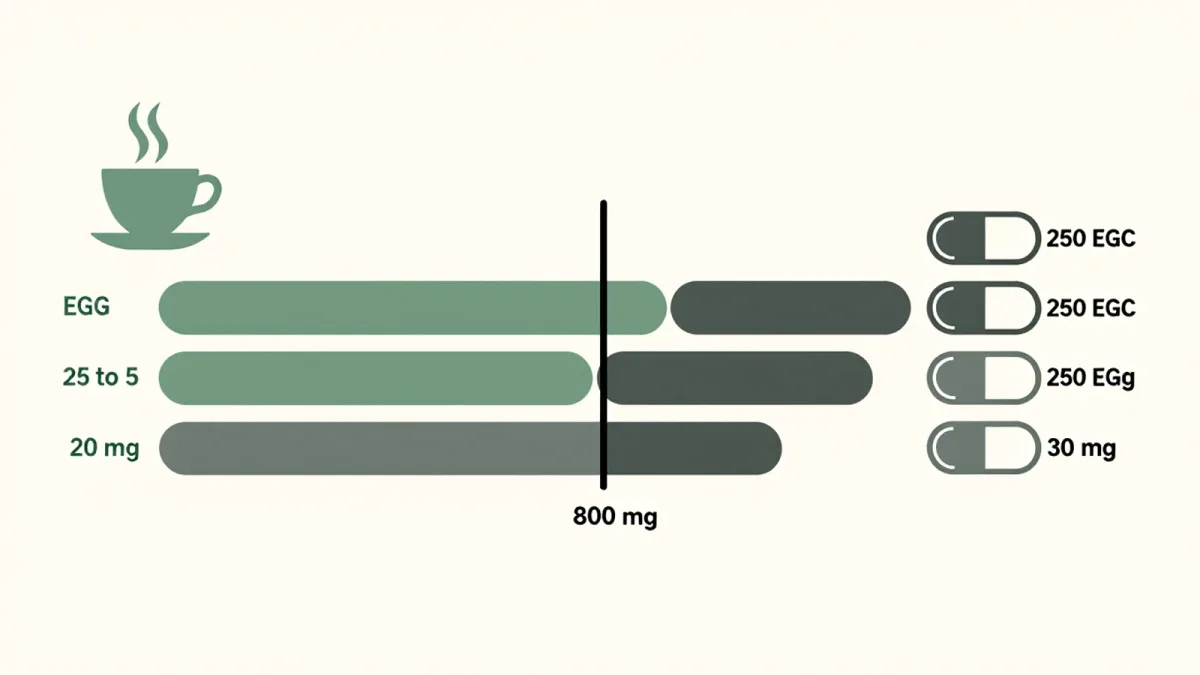
Brewed green tea delivers roughly 50 to 100 mg of total catechins per cup, with EGCG around 25 to 50 mg, per the NIH Office of Dietary Supplements' background materials on tea. Concentrated extracts commonly provide 250 mg EGCG per capsule, and weight-loss formulations instruct two or three capsules daily — a routine that crosses the 800 mg line EFSA flagged before breakfast does. Fasting also matters mechanistically: EFSA's review found plasma EGCG exposure higher when taken without food, which is precisely how fat-burning labels advise taking them.
Who has been harmed, and who is most at risk?
The published cases skew toward women, middle age, and products marketed for weight control, consistent with the products' customer base; some cases involved multiple herbal ingredients, which complicates attribution and is a recurring honesty note in the literature. Genetic variation in catechin metabolism has been proposed as a susceptibility factor in preliminary analyses. What the record does not support is a population-wide incidence rate — hundreds of thousands take these products and the case count is in the hundreds — but a rare, serious, and largely avoidable risk concentrated at high doses is still a risk worth a label.
What should a careful label-reader check?
Three lines. The catechin content: a label that lists EGCG per serving lets you do the arithmetic against the 800 mg reference point; a label that does not list it has hidden the number that matters. The purpose: concentrated extracts marketed for weight loss are the category where the case reports cluster. And the symptoms: nausea, dark urine, jaundice, or unexplained fatigue during use are the pattern the case reports describe, and the correct response is stopping the product and contacting a clinician, not adjusting the dose.
Frequently asked questions
Is drinking green tea risky for the liver?
No liver-injury signal attaches to brewed tea in the regulatory record; the case reports concern concentrated extracts at multiples of the cup's catechin content. Epidemiology on tea drinking has generally been neutral to favorable.
How much EGCG is considered concerning?
EFSA's 2018 opinion linked doses of 800 mg EGCG per day and above to elevated transaminases, with fasting intake increasing exposure. Many weight-loss extract regimens reach or exceed that in a day.
Are green tea extract liver cases proven?
Individual case reports prove association with varying confidence, and some involved multi-ingredient products. The case for causation rests on the volume of reports, the reproducible enzyme changes, and EFSA's dose-response review — the weight of evidence, not any single case.
What should I do if I have symptoms on an extract?
Stop the product and contact a clinician promptly. Nausea, dark urine, jaundice, and right-upper-abdominal discomfort during weeks of use match the documented injury pattern, and liver blood tests are the way it is confirmed.