
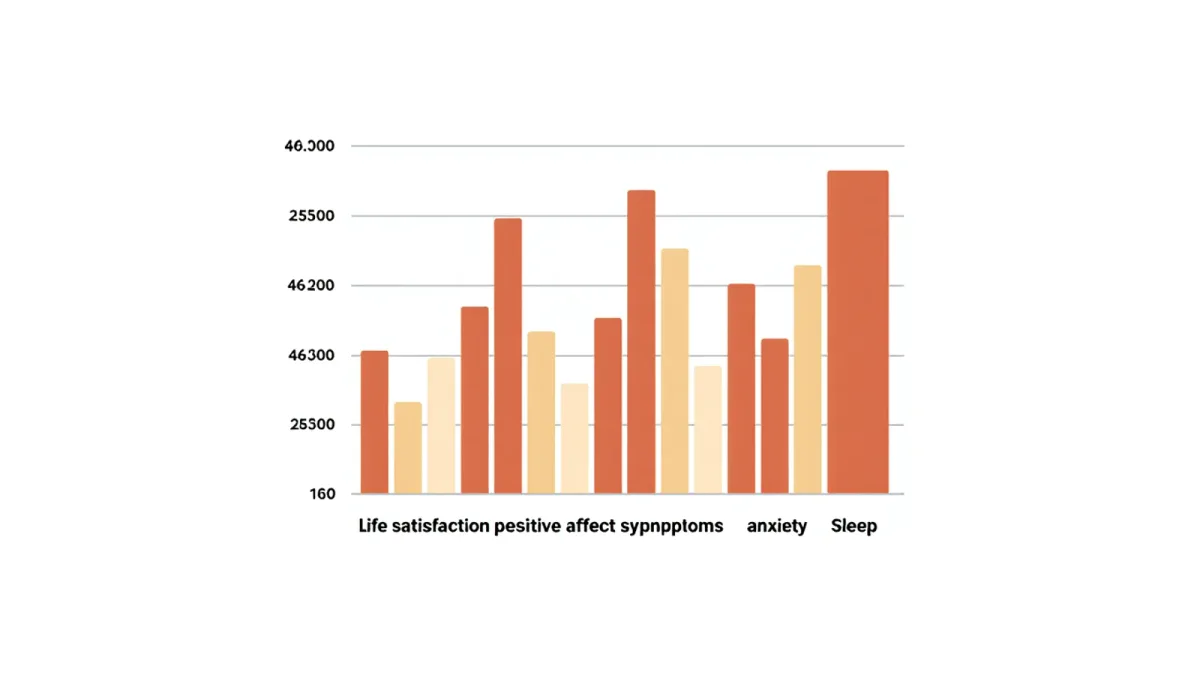
Short answer: gratitude journaling works modestly. A 2020 meta-analysis by Jans-Beken and colleagues in the Journal of Happiness Studies, pooling randomized trials of gratitude diaries, found small-to-moderate effects on subjective well-being — in the neighborhood of 0.3 in standardized terms — while effects on depression and anxiety symptoms were smaller and less consistent. The foundational 2003 experiment by Robert Emmons and Michael McCullough in the Journal of Personality and Social Psychology showed the mechanism in miniature: people who listed five things they were grateful for weekly reported fewer physical complaints and exercised about 1.5 hours more per week than a group listing hassles.
The house rule applies: newyorkhealthandbeauty.com publishes information, not medical advice. A gratitude diary is not a treatment for depression, and anyone experiencing persistent low mood should bring it to a clinician rather than a notebook alone.
What does a gratitude journal study actually test?
The canonical design is simple: one group writes several things they are grateful for a few times a week, a comparison group lists neutral events or hassles, and both complete validated mood and well-being scales before and after several weeks. Variants include gratitude letters — writing and sometimes reading a letter of thanks to someone — and brief app-based prompts. This matters because the label "gratitude journaling" covers interventions of very different intensity, and the meta-analytic averages blend studies asking participants to write five lines with studies building structured reflection exercises over ten weeks.
How big are the effects, and on what?
The pattern across reviews is consistent. Effects are largest on positive affect and life satisfaction — the subjective well-being measures — where meta-analyses published through 2023 report standardized effects around 0.25 to 0.35. Effects on negative outcomes shrink: symptom measures of depression and anxiety move less reliably, and a 2017 review by Davis and colleagues in the Journal of Positive Psychology concluded that gratitude interventions have modest effects on well-being but inconclusive effects on reducing psychological symptoms. A 2023 systematic review of gratitude interventions in clinical populations reported preliminary benefits for adults with emotional difficulties, while cautioning that most trials were small and short — weeks, not months, with little follow-up.
| Outcome | Typical meta-analytic effect | Consistency |
|---|---|---|
| Life satisfaction / positive affect | d ≈ 0.25–0.35 (small-to-moderate) | Consistent |
| Depressive symptoms | Small, near-zero in some trials | Mixed |
| Anxiety symptoms | Small, less studied | Mixed |
| Physical health markers | Self-reported improvements only | Weak |
| Sleep quality | Positive in a few trials | Preliminary |
Related stories: Breathwork and Stress: What the Effect Sizes Actually Say · A Week Without Feeds: What Digital-Detox Experiments Actually Find.
Why would listing blessings move anything?
The proposed mechanisms are attentional and social. Gratitude practice, on the attentional account, counteracts a documented human bias toward noticing threats and slights — the "counting blessings versus burdens" contrast in the 2003 experiment was built to test exactly that. On the social account, gratitude is inherently relational: writing what one is thankful for tends to surface specific people, and gratitude-letter studies show some of the strongest short-term mood effects when the letter is actually delivered. Neither mechanism predicts dramatic effect sizes, which is one reason the modest numbers should be read as the honest result, not a failure of delivery.
Does gratitude journaling hold up over time?
This is where the field is thinnest. Most trials measure immediately after the intervention period, and follow-ups beyond three months are rare; the Jans-Beken meta-analysis noted long-term evidence was lacking. There is also a repetition problem the research has begun to document: the same five-item list, written nightly, can decay into a chore, and some trials found effects shrinking as practice became routine. The practical inference — vary the content, write briefly but specifically, and skip guilt-driven marathon sessions — comes from the trial designs themselves, which succeeded with short, specific entries two to three times weekly rather than daily volumes.
How does it compare with other wellness practices?
For context: the effect sizes in the gratitude literature are comparable to those reported for slow-breathing and other brief positive-psychology exercises — modest, meaningful at the population level, easy to overstate in marketing. None of these brief practices rivals the effect sizes of structured psychotherapy for clinical depression. The realistic framing is additive: a free, five-minute practice with small positive effects and essentially no documented downsides, best understood as one input among several rather than a stand-alone intervention.
What about the widely quoted happiness numbers?
Popular coverage of gratitude research often repeats large percentages — “25 percent happier” and similar — that trace to small subsamples and single experiments rather than the pooled evidence. The 2003 Emmons and McCullough paper itself reported across multiple experiments with varying comparison groups, and its most replicated specific finding was behavioral: the weekly gratitude group exercised about an hour and a half more each week and reported fewer physical complaints. Headline percentages built on one arm of one study have a way of surviving their caveats, which is precisely why the meta-analytic effect of roughly 0.3, unglamorous as it is, is the number to carry into any purchase or habit decision. In a city where gratitude workshops now carry studio-class pricing, the gap between the pooled effect and the marketed promise is worth the price of a notebook.
The bottom line
Gratitude journaling earns a qualified pass: around 0.3 on well-being outcomes in meta-analyzed trials, small and mixed effects on depression and anxiety, and little long-term follow-up anywhere in the literature. Written specifically, two or three times a week, it is a fair bet — marketed as transformative, it outruns the data.