
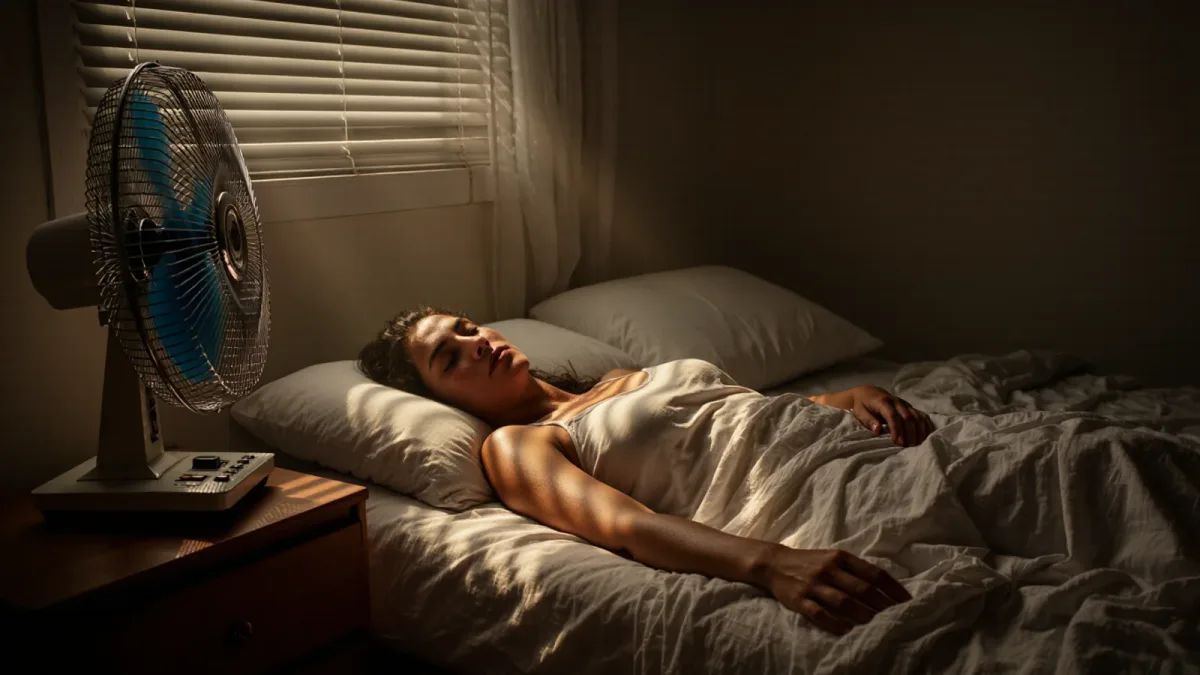
The sleep-friendly bedroom sits near 66 to 70 degrees Fahrenheit, and physiology enforces the range: reviews of sleep and thermal environment, including Okamoto-Mizuno and Mizuno's 2012 synthesis in the Journal of Physiological Anthropology, found that heat and humidity increase wakefulness and suppress REM sleep and slow-wave sleep. One counterintuitive tip has trial support behind it — a warm bath taken one to two hours before bed reduced sleep onset latency by about 10 minutes in a 2019 meta-analysis in Sleep Medicine Reviews — because it triggers heat loss afterward.
This site publishes information, not medical advice. Heat illness, breathing difficulty in heat, or chronic insomnia are conditions for a clinician, and older adults and people on certain medications face elevated heat risk.
Why does heat ruin sleep?
Because falling asleep is, physically, a cooling event. Core body temperature drops roughly one degree Fahrenheit in the approach to sleep and keeps falling through the night, and the body sheds that heat through dilated skin vessels and evaporative cooling. A warm, humid room blocks both routes: sweating becomes less effective when the air is saturated, and the core temperature decline that initiates and maintains sleep stalls.
The measurable consequences follow the mechanism. In heat-exposure sleep studies, subjects wake more often, spend less time in REM and slow-wave sleep, and report poorer subjective rest — with the early-morning hours, when core temperature normally reaches its minimum, showing the greatest disruption.
Which hot-weather sleep tips have real evidence?
Not all of the folklore survives, and the winners are the ones that help the body dump heat:
- A warm shower or bath, 1–2 hours before bed. The 2019 meta-analysis by Haghayegh and colleagues found water at roughly 104–108 degrees for at least 10 minutes cut sleep latency by around 10 minutes — the warm soak pulls blood to the skin, and the subsequent heat loss mimics the natural pre-sleep decline.
- Cooling the head and feet. These regions shed heat efficiently; trials of head cooling and the long-standing use of lower-limb ventilation in Japanese summer-sleep research support directing airflow at extremities rather than the whole room.
- Bedroom cooling to the 60s. Air conditioning or a cross-breeze that holds the room near 66–70°F aligns with the sleep-research consensus; every degree of humidity control helps evaporative cooling work.
- Light bedding, breathable covers. Reduces the microclimate heat trapped under blankets, which studies identify as a distinct sleep disruptor from room temperature.
The losers: a cold shower immediately before bed, which constricts skin vessels and can blunt the heat loss that matters; alcohol, which speeds sleep onset while suppressing REM and dehydrating; and exercising hard late in a hot apartment, which raises core temperature at precisely the wrong hour.
The governing principle from the physiology: sleep begins with cooling. Every intervention that helps heat leave the body helps sleep arrive; every one that traps heat defeats its own purpose.
Related stories: Skincare Order, Explained: The Morning Sequence That Actually Matters · Meal Timing and Metabolism: What the Research Shows About When You Eat.
Do fans actually help in extreme heat?
Below about 95 degrees, yes — above that, physiology gets complicated. Fan airflow accelerates evaporation and convection, and public-health guidance has long endorsed fans in ordinary heat. But at very high air temperatures fans move hot air across skin and can increase heat gain, which is why heat-safety materials advise cooler strategies — cooler rooms, air conditioning, showers — during extreme heat events, especially for older adults whose sweat response is blunted.
In New York's summer housing stock — prewar apartments with radiator heat long gone but cross-ventilation often blocked, and window units fighting top-floor heat — the practical version is simple: the coolest available room beats the customary one, and airflow aimed at the bed beats airflow aimed at the wall.
What about hydration and evening routines?
Hydration supports sweating, and sweating is the cooling system sleep depends on; mild dehydration shows up in sleep studies as more wakefulness. But the timing advice cuts both ways — a large glass of water at midnight trades heat relief for a 3 a.m. bathroom trip, another fragmented-night classic. Front-load fluids through the day, taper in the last hour, and keep the bedroom dark: blackout conditions matter more, not less, in summer, because early sunrises and long evenings shorten sleep from both ends at once — dark, cool, and quiet remain the whole assignment.
| Tip | Evidence status | Practical note |
|---|---|---|
| Warm bath 1-2 h before bed | Supported by meta-analysis | 104-108°F, 10+ minutes |
| Room in the 66-70°F range | Consistent research consensus | Cooler room beats colder shower |
| Fan on skin | Supported below ~95°F | In extreme heat, choose a cooler room |
| Cold shower before bed | Not supported | Blunts heat loss; shower earlier |
| Nightcap in hot weather | Contradicted | Alcohol suppresses REM, dehydrates |
The bottom line
The physiology gives hot-weather sleep a single test — does the intervention help the body shed heat at the hours when it wants to? A warm bath an hour or two before bed, a bedroom held in the 66-to-70-degree range, airflow on skin below extreme temperatures, and light bedding pass it; cold showers, late alcohol, and midnight hydration do not. Summer nights will still be shorter — the early sunrise sees to that — but they can be measurably less broken.