
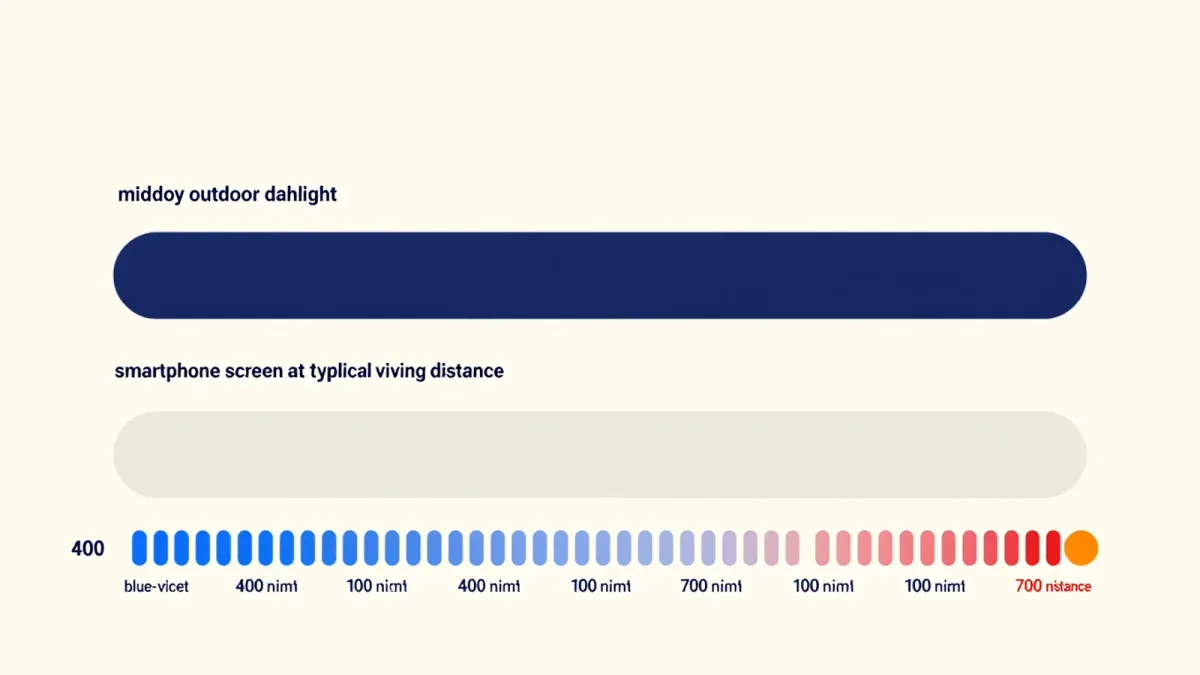
Phone and laptop screens do emit blue light — the blue-violet band from roughly 400 to 490 nanometers — but at intensities many hundreds of times lower than outdoor daylight, and the published evidence that this device-level exposure damages skin is weak. Where the science is genuinely interesting: a 2015 study in Skin Pharmacology and Physiology by Vandersee and colleagues found blue-violet light produced more lasting pigmentation in darker skin types than comparable doses of red or green light.
This site publishes information, not medical advice. Questions about melasma, persistent dark spots, or any diagnosed skin condition belong with a dermatologist.
What is blue light, exactly?
Blue light, sometimes called high-energy visible light or HEV, is the shortest-wavelength slice of visible light — roughly 400 to 490 nanometers — sitting just past ultraviolet on the spectrum. Its energy per photon is higher than that of red or green light, which is why researchers began asking whether it could generate oxidative stress in skin the way UVA does, only less efficiently.
The sun is the dominant source by a wide margin. Outdoor daylight delivers blue-light doses that dwarf what a screen produces at typical viewing distance, which is why the National Eye Institute's materials on visible light focus on the eye and sun exposure rather than devices.
Do screens damage skin the way UV does?
No credible published study has shown that ordinary screen exposure produces measurable skin damage comparable to UV. Laboratory work — including Opländer and colleagues' 2011 experiments on human dermal fibroblasts in Photochemistry and Photobiology — found that high-dose blue light can generate reactive oxygen species and affect mitochondrial function in cells, but the doses used in cell culture far exceed what a face receives from a phone display over a working day.
The gap to watch is the one between a petri-dish dose and a commute-and-desk dose. Most of the alarming headlines are built on the first and sold as the second.
What did the pigmentation studies find?
This is the one thread with direct human data. Vandersee and colleagues, publishing in 2015, exposed small patches of volunteers' skin to controlled blue-violet light and tracked pigmentation for up to three months. In skin types III and higher — medium to deep tones — the blue-violet exposure produced pigmentation that persisted for weeks, unlike the fading response seen with red or green light. Earlier work by Liebel and colleagues in 2012 reported that blue light triggered a longer oxidative response in skin than comparable UVA exposure.
Two honest caveats. The exposures in these studies were measured in joules per square centimeter — calibrated lamps, not phones — and the results apply most clearly to deeper skin tones and to conditions like melasma, where pigment is already unstable. They do not demonstrate that scrolling before bed causes dark spots.
Related stories: Silk Pillowcases for Skin and Hair: What the Claims Survive Contact With Evidence · Skincare Order, Explained: The Morning Sequence That Actually Matters.
Do blue-light skincare products do anything?
The marketing moved faster than the data. Iron oxides are the one ingredient category with reasonable support: studies comparing sunscreen with and without iron oxides have found better visible-light protection for pigmentation-prone skin, and a 2021 study in the Journal of Cosmetic Dermatology by Dumbuya and colleagues, funded by a pigment manufacturer, supported tinted formulations for visible-light defense — a brand-adjacent funder, disclosed here as such.
"Anti-blue-light" serums, on the other hand, are largely antioxidant formulas rebranded for the moment. Antioxidants have their own modest evidence base; the blue-light framing is an addition, not a new finding. A brand's claim about a product's blue-light protection is the brand's claim, and none of the major sunscreens sold in the United States is regulated to a visible-light standard the way they are to an SPF standard.
| Claim in circulation | What the evidence shows |
|---|---|
| Screens cause premature skin aging | No human study at device-level doses; cell studies use far higher exposures |
| Blue light deepens pigmentation in darker skin | Supported at controlled lamp doses; device relevance unproven |
| Iron oxides help protect against visible light | Reasonable support, strongest for melasma-prone skin |
| Serums can "block" blue light | Brand claims without an independent testing standard |
Why did screens get blamed in the first place?
The timing explains most of it. Skin research on visible light accelerated in the early 2010s, screen time was climbing in the same years, and the two stories fused into a single consumer fear — one that device makers and skincare brands alike found profitable to answer. What got lost in the fusion was the dose: the studies that demonstrated blue-light biology used calibrated lamps at intensities measured in joules per square centimeter, while a display at arm's length delivers a fraction of that, and outdoor daylight dwarfs both. The plausible-sounding bridge between laboratory finding and phone screen was never built by any study.
Should you change anything?
If melasma or post-inflammatory pigmentation is a concern, the conversation worth having with a clinician is about broad-spectrum and tinted sunscreens with iron oxides — because daylight, not devices, is the visible-light exposure that dominates. For everyone else, the evidence does not justify a screen-time panic or a new cabinet shelf. Sun protection remains the step with proven outcomes; blue light from devices, at current published doses, is a footnote to it.
The bottom line
Blue light is real light with real biology attached, but the dose from screens sits far below anything shown to harm skin in controlled studies. The documented pigmentation effects come from calibrated lamps at doses that dwarf a phone's output, and they matter most for deeper skin tones and pigment disorders. Daylight and sunscreen are the variables that move the needle; device exposure, on the evidence available, barely does.